|
12. And as each group of 2-dimensional circles
yields 2-dimensional polygons which in turn yield 3-dimensional
polyhedra, so each group of 3-dimensional spheres yields 4-dimensional
polyhedra, also known as Polytopes. The Fourth dimension is an
angle perpendicular to the other three, X, Y, and Z. Often Time
is considered to be this angle. Another possible interpretation
is a spatial one, representable in terms of Scale. 4-dimensional
polyhedra can be rather complex when realized in 3-dimensional
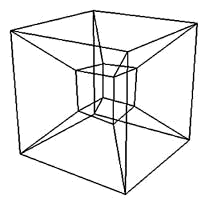
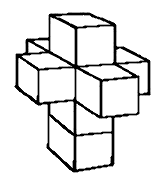
space due to the perceptual constraints of our 3d world. The famous
example is the Hypercube, which might be rendered as a smaller
cube within a larger, or a cube projecting cubes out of each of
its faces, and two out of the bottom, like a Cross.
back | next
|


